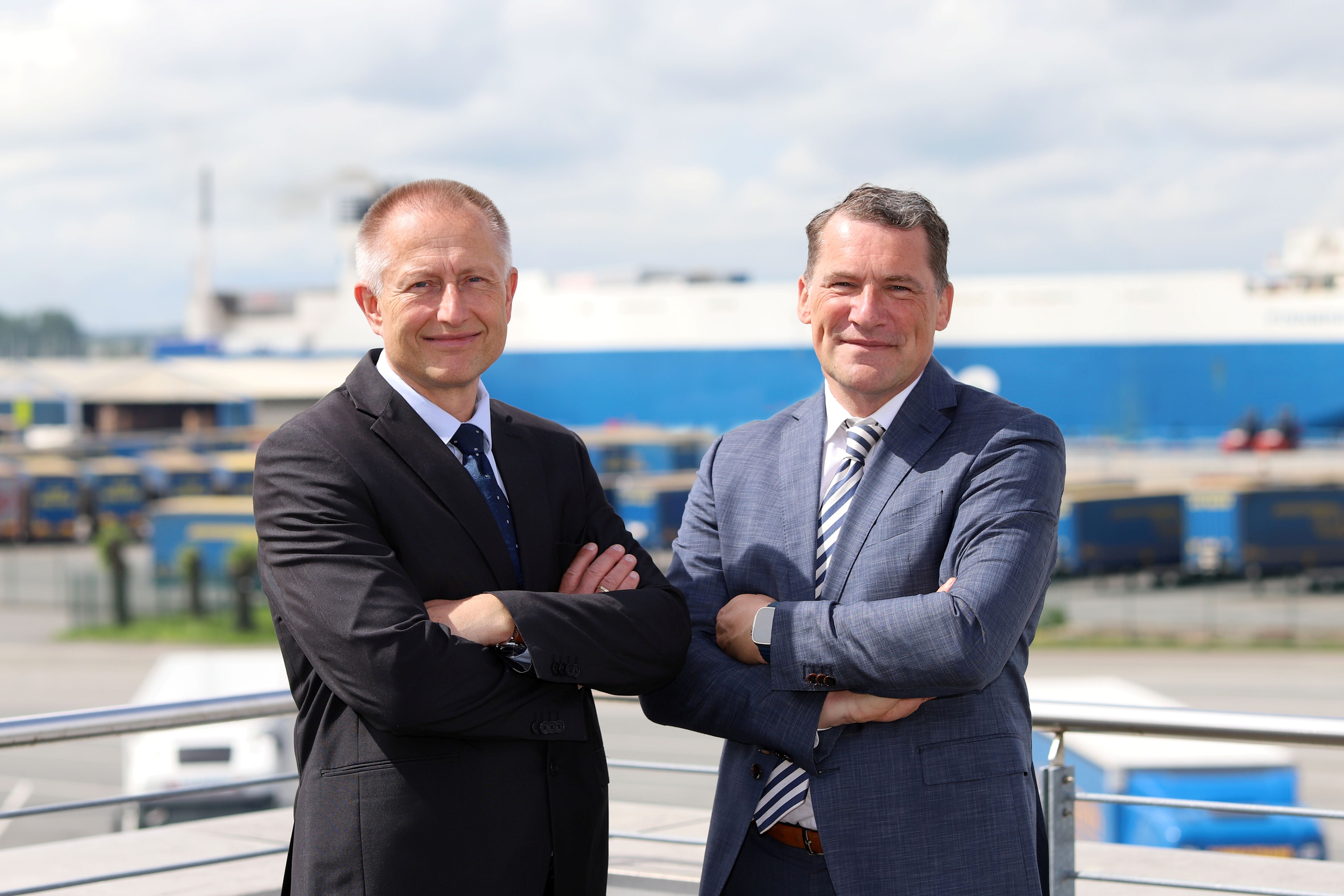
Rostock has time and again reached all-time highs in cargo handling, all while navigating unprecedented supply-chain reshufflings, and is positioning itself as a green-energy hub for Northern Europe. We asked the port’s two managing directors how different drivers have tested its resilience, what’s in Rostock’s development portfolio, picked their brains about onshore power supply and the green shipping corridor concept, to round up with insights into which energies will propel the future
- What drives cargo and passenger vol-umes in Rostock – in the past, nowadays, and in the foreseeable future?
The stevedores, shipping lines, and all other parties involved in transport and logistics in and around the port succeeded in marking the past couple of years as all-time highs for Rostock cargo-handling-wise (and the cruise and ferry passenger businesses also did not disappoint). Given its multipurpose character, Rostock Overseas Port is to a certain degree immune to Germany’s internal state of economic health. Grain exports, for instance, depend more on weather and international demand. On the other hand, crude oil imports – a major driver of volume growth lately – can be unpredictable. Nobody foresaw the Russian war of aggression against Ukraine, and how it would reshape both regional and global supply-chain patterns. The PCK refin-ery in Schwedt, which in the past received its feedstock from the east by pipeline, had to switch to getting the bulk of it via our seaport. We were prepared to handle this virtually overnight. “Redundancy” is cer-tainly a word that resonates these days – as it did when the modern history of Rostock Overseas Port began in the 1960s. Then again, we lost a lot of cargo from the east, mostly dry bulk goods like coal or grains, replaced by trades with Africa or South America. New businesses emerged as well, vehicles being the prime example. Autolink rose from 32,000 in their first year of operations (2023) to 120,000-130,000 cars per annum today.
Certain remnants of the coronavirus pan-demic persist as well. While figures for the cruise sector are good, with Rostock easily claiming the title of one of Top 3 destina-tions in the Baltic, the traveller composition has changed noticeably. Today, we are more of a home port for German guests in contrast to having a lot more travellers from abroad in the past, including Americans and Asians who might still be too worried to be locked out-side their regions should corona-bis happen. However, we sincerely hope these customers will come back to Europe eventually. Container traffic was another casualty of COVID-19. We invested considerable effort in making Rostock known in China for goods moving by rail over the New Silk Road to Kaliningrad and then to us by sea, thereby avoiding costly congestion at the Brest-Małaszewicze border crossing. That was valuable traffic, and other ports in the Baltic also had to say farewell to it.
Lastly, Rostock is also a NATO port, with the Organization’s new Combined Task Force Baltic HQ opening here in the autumn of 2024. Having naval vessels come in and out of the seaport is one thing; logistics for the military is another. It is a trade, a specific one indeed, but business nonetheless, with mili-tary cargo potentially routed via our inter-modal terminal. Germany might see higher spending on security in the coming years, some of it channelled towards maritime infra-structure. The key challenge may lie else-where, though. If ports are to achieve even higher security given the current geopoliti-cal climate and the trajectory through 2026 and beyond, someone will need to tackle that challenge. But it is the role of specialised agencies to aid us here, not necessarily for port authorities to become quasi branches of the defence ministry.
As for traffic itself, business proves to be rel-atively stable. However, the various cargo groups performed differently in the first quarter of 2026. Bulks, liquid and dry alike, are slightly below the previous year’s level, while ferry and ro-ro are above it. Overall, cargo handling remains at a high level. In the present challenging environment – e.g., whatever is or isn’t happening in the Strait of Hormuz – it’s virtually impossible to make reli-able predictions for the full year at this time (let alone beyond). That said, Rostock benefits from a highly diversified cargo structure and therefore has comparatively strong resilience against disruptions in individual market seg-ments. Our business is strongly rooted in the Baltic Sea region, particularly in north-south trades with Finland and Sweden. As such, we would not expect direct operational impacts comparable to those experienced by major global container hubs. Yet, geopolitical crises naturally influence the overall economic envi-ronment. The most relevant issue would be volatility in energy prices – especially oil, gas, and fuel costs. Such developments affect shipping companies, industrial customers, and logistics chains throughout Europe.
- How about Rostock’s hinterland, espe-cially the intermodal part, as the rail sector has been having its fair share of troubles lately?
Intermodal transport remains a key strategic business segment for us and an essential component of sustainable logistics chains between Scandinavia and continental Europe. In 2025, nearly 110,000 intermodal units were handled at the port. It was a year-on-year downtick of 1.7%, partly due to reduced service frequencies on individual routes but primarily the result of the persistently weak economic environment.
The rail freight sector is facing several struc-tural challenges. Rising energy prices are increasing track access charges imposed by the German rail infrastructure manager, and numerous construction projects on the country’s railways are causing operational disruptions and longer transit times due to major detours. As always, rail freight vies with trucking, which benefits from flexibility, comparatively low costs, and well-developed road infrastructure. Nevertheless, rail and intermodal transport offer clear long-term advantages: significantly lower energy con-sumption and CO₂ emissions, support for cli-mate-friendly logistics chains, and high trans-port capacity, with one train carrying 38-42 trailers or over 50 containers. Because of that, Rostock Overseas Port continues investing in rail infrastructure and intermodal capacity, including extending five terminal tracks to 680 metres each. The benefit will be twofold. First, longer trains equal more cargo, which results in lower transportation costs per unit. Second, it will take only one track to form an entire train set, effectively doubling the facility’s capacity.
- Can you walk us through the completed, running, and planned developments?
As operator of Germany’s largest universal port on the Baltic Sea, we continue to invest sub-stantial double-digit millions annually into the modernisation and expansion of port infra-structure – some €33 million last year and over €60 million in 2026 (altogether €700 million since 1990). In recent years, we have already completed major investments in the accessi-bility of the ferry and ro-ro terminal, in modern deep-water berths, and in the digitalisation of operational processes.
One recent milestone was the modernisation of infrastructure under the EU-supported Rail-IT-MoS programme together with our part-ners from the Port of Trelleborg. This included railway refurbishment, implementing digital trailer handling solutions, and deploying other intermodal transport operational improve-ments. The project was part of a broader EU Motorways of the Sea initiative between Rostock and Trelleborg. Over three years, both ports saw investments of around €15 million, with our share amounting to €6.4 mil-lion. While our Swedish friends completed the eastern harbour area as the final step of their port relocation plan, we carried out extensive hard- and software infrastructure upgrades. The rail-bound connection of berth 64 for the rail ferry of Stena Line was long-term secured through new switches (14 in total) and tracks. In addition, handling capacities were signifi-cantly increased by creating additional pre-stowage areas in the ferry and ro-ro terminal – west of Wharf Hall 9a and at landing-place 67 (this one necessitated gangway demoli-tion). We also widened a ramp at berth 62, added a dolphin at berth 63 for larger ves-sels, and installed two new floodlight masts in the ferry terminal (which also received a passenger elevator).
Parallel to these efforts, the digitalisation of port operations was advanced to ensure future readiness, particularly through upgrades to the scanning and check-in facilities at the north-ern trailer gate (cameras, sensors, lighting, and new kiosks), and the expansion of Wi-Fi avail-ability on the terminal via LTE antennas, pol-icy-based routers, and hand-held devices for tug-master drivers. Finally, an API joined the terminal management system and solutions used by the ship operators. These investments sustainably support future ferry traffic on the shortest sea route between continental Europe and Sweden, which also includes securing the operation of the only rail ferry active in the EU part of the Baltic Sea region.
Currently, our most important ongoing projects include the reconstruction of berths 33 and 34 at Pier II, an investment of nearly €20 million that will bring some of the oldest quay infra-structure in the port up to speed with modern operational standards. Next, we’re redeveloping approximately 10 hectares south of Basin A for future logistics and terminal expansion. We are meanwhile preparing one of our strate-gically most important future investments: the new deep-water berth 5 in the eastern oil port area. This project is intended to secure future energy imports, including renewable energy carriers like hydrogen derivatives, all aimed at strengthening Germany’s energy resilience. In addition, we continue investing in hydrogen infrastructure and in preparing the port for future green energy logistics.
-
- Having mentioned transport’s carbon footprint – what is your take on the green shipping corridor concept?
Rostock Overseas Port benefits from rela-tively short port lay times, enabling more effi-cient use of vessels, terminal infrastructure, and overall resources. We have also been an early mover in alternative fuels, introduc-ing LNG bunkering fairly quickly, and now exploring the initial development of hydro-gen derivatives and related technologies. In parallel, shore-side electricity services are already established in the cruise sector, while similar solutions for wheeled traffic are cur-rently under discussion together with ferry and ro-ro operators. Berthing time plays a crucial part here – ships need to stay in the port long enough to make cold ironing worthwhile. For example, Scandlines’ ferries can spend as little as 15 minutes at berth. The overwhelming majority of ferry calls do not go over the two-hour threshold, a testament to how efficiently operations are organised in Rostock (which, in addition, makes it pos-sible to slow steam, another bonus for the environment). On the flip side, it makes the business case for cold ironing all the more difficult – particularly if we’ll be obliged to install additional stations regardless.
We see shore power as an essential tech-nology for the decarbonisation of maritime transport and expect further expansion in the coming years. But one thing is for certain – advancing sustainable maritime operations is a team sport that requires close coordination and joint projects with shipping companies (and EU and governmental support, for that matter). We know that this can be done suc-cessfully, as evidenced by our Warnemünde cold-ironing station at two berths for cruise ships. Nowadays, more cruisers ‘plug in’ than not, and we expect the utilisation rate to keep rising. To date, the experience has been encouraging – local emissions, includ-ing noise pollution, went down significantly, which resulted in positive feedback from resi-dents. The Warnemünde-investment also had the right logic behind it, with cruise lines creating the demand for it.
From the German side, Rostock offers a unique advantage as a key option for combined rail-ferry transport connections, supporting the continued expansion of intermodal solu-tions and greener end-to-end supply chains. As things stand today, a trailer can reach our quays by rail from as far as Italy or Romania, get loaded on a ferry, and then travel by rail again to Gothenburg or Stockholm via Trelleborg versus running by truck through all of Central Europe. In this sense, Rostock is already a green highway. The future focus would be on further trimming emissions, including the provision of green fuels for shipping.
- What developmental plans do Rostock and its partners have in the field of future energy carriers?
This topic is inseparably tied to land avail-ability, one of the key strategic issues for the long-term development of the port. This is why we are actively involved in the Zukunftshafen Rostock (Rostock’s Future Port) initiative together with the Hanseatic and University City of Rostock, regional plan-ning authorities, and economic partners. The aim is to ensure that port development remains integrated into future spatial and infrastructure planning. We are therefore focusing not only on expansion but also on more efficient land use, refurbishment of existing areas, and the creation of modern logistics and industrial zones within the cur-rent port boundaries.
The redevelopment south of Basin A is an important example of this strategy. Future growth will probably focus on energy logis-tics, hydrogen infrastructure, renewable energy industries (including offshore), and high-value intermodal logistics. Rostock’s rail access and industrial hinterland connections make it a potentially attractive future hub for alternative energy logistics. We have tra-ditionally been an energy port. Today, how-ever, we are actively supporting the transfor-mation towards renewable and sustainable energy systems: green ammonia, hydrogen and its derivatives, and other renewable fuels. Awarded funding as an Important Project of Common European Interest, HyTechHafen Rostock is one of the key projects in this area. It involves a 100-megawatt electrolyser for the production of green hydrogen, some 6,000 tonnes annually. At the same time, we are investigating the setup of infrastructure for importing green energy carriers. The tricky part is that, given the uncertainty of what will become of the German economy (especially its industrial component), it’s challenging to get concrete off-take commitments penned on paper. We may see some intermediate developments towards a truly green future. Before the hydrogen economy matures at scale, transitional steps are likely – such as the local coal-fired power plant switching to biomass or even being converted to use some other eco-friendly feedstock altogether. One way or another, our objective is clear – to position Rostock not only as a successful universal port but also as a resilient, innova-tive, and sustainable logistics and energy hub (production and import) for Northern Europe. As we see it, future-oriented growth is the only viable solution on the table.
Weiter zur Online Ausgabe: Baltic Transport Journal