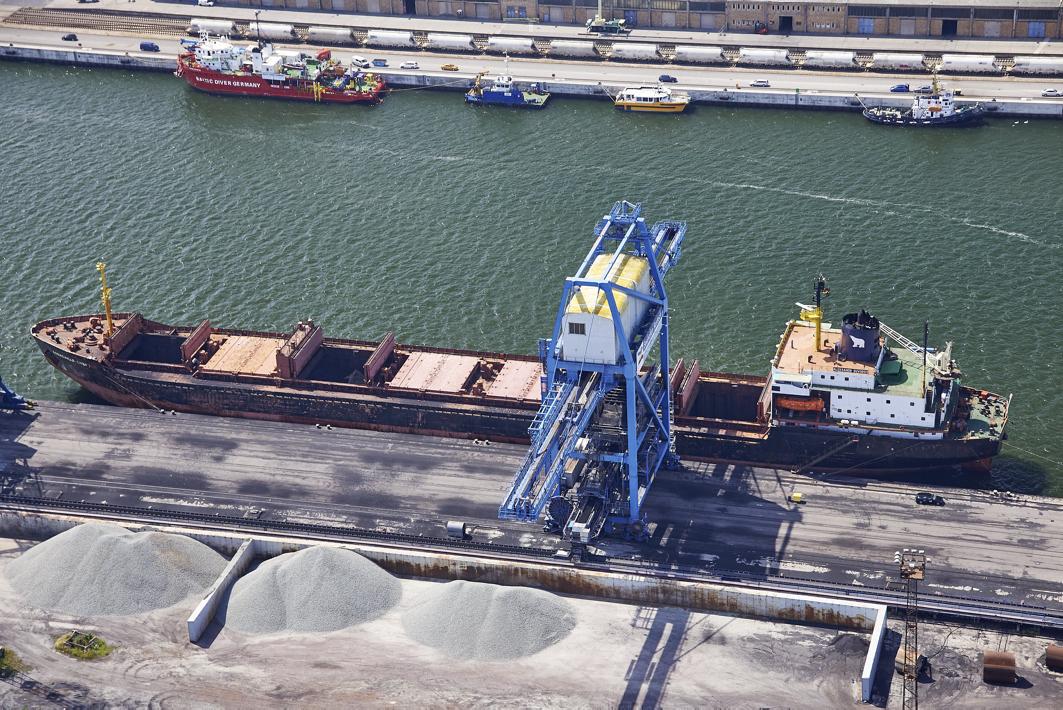
Bulk terminal
Germany’s largest grain export port
Bulk goods
Up to 20,000 tonnes of coal can be unloaded daily at berths 23 and 24.
Overhead cranes are used to unload sea gravel, limestone, chippings and peat (berth 22). At the centre of Pier III is a storage area for 300,000 tonnes of hard coal. Conveyor belts ensure a steady supply to the neighbouring 500 MW hard coal-fired power station. Berth 21 houses a processing plant for sea gravel and storage areas for building materials, agricultural products, fertiliser and other bulk goods. Handling is carried out using a mobile harbour crane with a lifting capacity of up to 84 tonnes.
A total of 420,000 square metres of open-air storage and 55,000 square metres of covered storage are available in the port for bulk goods.
In addition to coal handling, the most significant bulk goods handled at the Port of Rostock include, in particular, building materials, fertilisers and grain.



2024 Port Process – Bulk Goods
Accounting for around 20 per cent of total maritime cargo handling, bulk goods are among the key cargo types at the largest general-purpose port on the German Baltic Sea coast. The main goods handled here include gravel, lime, peat, wood chips, gypsum, as well as fertilisers and coal. At Pier III, the port has adapted the infrastructure at the bulk cargo quay to meet the growing demands of the market in recent years. Track systems have been renewed, the load-bearing capacity of the quay area has been increased from two to five tonnes per square metre, and the fairway in the harbour basin has been deepened. In addition, Euroports Germany, as the largest port operator in the area, has invested in a high-performance, fully electric gantry crane, thereby contributing to the efficient and low-emission handling of bulk cargo at Pier III.
17. Januar 2025
5.9 million tonnes
Cereals are the predominant type of bulk cargo
Bulk cargo handling totalled 5.9 million tonnes, 16 per cent higher than the previous year. Growth was recorded in building materials, fertilisers, coal, animal feed and oilseeds. With an annual volume of 2.4 million tonnes, grain remains the dominant type of bulk cargo at the overseas port, despite declines.

Annual statistics on bulk goods 2025
For bulk goods, the port has a total of 420,000 square metres of open-air storage and 55,000 square metres of covered storage, as well as grain silos with a storage capacity of 691,000 tonnes. Alongside grain handling, the most significant bulk goods handled at the Port of Rostock include, in particular, building materials, fertilisers and coal.
Contact person
ROSTOCK PORT
ROSTOCK PORT GmbH
Herr Götz Strahl
Head of Port Logistics
Herr Daniel Krampikowski
Head of Sales

