A total of 16.73 million tonnes of cargo passed the edge of the quay in the port city on river Warnow during the first half of 2026. „Of these, 15.9 million tonnes were handled at the Overseas Port, more than ever before in the first six months of a year. That means 100,000 tonnes more than the previous record half-year 2023. Cargo handling results at Rostock Overseas Port have been at record level for four years now. The individual results of cargo types in the first half of 2026 differ, however: While handling of liquid goods and general cargo declined slightly there were increases in dry bulk as well as ferry and ro-ro goods. Ferry passenger traffic to and from Northern Europe also reached a high level again“, states Dr. Gernot Tesch, managing director of ROSTOCK PORT.
According to the city’s port and shipping authority, around 830,000 tonnes (plus 30,000 tonnes) were handled at the other port facilities in Rostock such as the Cargo and Fishing Port and the Chemical Port of Yara.
The number of ferry passengers carried via Rostock achieved nearly last year’s level at 1.01 million.
ROSTOCK PORT managing director Jens Scharner emphasises: „All the port companies and public authorities active in and around the port in Rostock, especially the shipping companies, cargo handling companies, forwarders and railway companies operating here have, by working together, contributed to Rostock Overseas Port once again demonstrating its enormous efficiency deriving from its all-purpose character“.
Rostock Overseas Port
Of the total of 15.9 million tonnes of goods handled from January to June, 8.8 million were moved at the ferry and ro-ro terminal. This was equivalent to a remarkable plus of around 400,000 tonnes more than in the previous year. The ferry and ro-ro goods thus accounted for 55 percent of the half-year handling result at the all-purpose port of Rostock. Handling of bulk and general cargo amounted to 7.1 million tonnes.
Rostock Overseas Port recorded 3,547 port calls (2025: 3,712) in the first six months of the year, 2,800 (2025: 2,878) of which were port calls by ferries and ro-ro vessels.
Wheeled cargo
206,400 trucks (escorted units) were carried on the three ferry and three ro-ro services to and from Denmark, Sweden and Finland, 10,300 more than in the same period last year. Handling of unescorted units also increased: 74,000 trailers and other cargo units rolled on and off the vessels (plus five percent). In addition 10,300 railway wagons (minus five percent) and over 58,000 new cars (minus 17 percent) were moved via Rostock in the first half of 2026.
Intermodal transport off to a difficult start
Transport of intermodal units was difficult at the beginning of the year when some trains were cancelled due to the winter weather, but it picked up speed again in subsequent months.
The terminal operator Rostock Trimodal (RTM) moved around 55,000 units during the first six months of the year (minus three percent compared to the previous year). The company expects a stable end-of-year result on the level of the previous year. But the line closures resulting from rail corridor refurbishment projects of DB InfraGO all across Germany that are expected to continue into the mid-2030s will continue to reduce traffic volumes.
Currently there are 44 weekly intermodal transport trains to and from Verona (19) and Padua (6) in Italy, to and from Bratislava (5) in Slovakia, to and from Oradea (2) in Romania, and to and from Karlsruhe (3), Dresden (5), Herne (3) and Halle (1) in Germany.
Bulk goods and general cargo
There was a slight decrease in the handling of liquid goods. Until the end of June 3.8 million tonnes were pumped across the edge of the quay, which was 180,000 tonnes less than in the first half of the previous year. The crude oil imports for PCK Schwedt amounted to nearly three million tonnes. More biodiesel, fuel oil and rapeseed oil but less petrol, gas oil and methanol were handled.
At 2.9 million tonnes the handling of dry bulk was about 140,000 tonnes above the result of the first six months of 2025. The highest share in dry bulk handling was again contributed by grain handling with 1.2 million tonnes even though this was about 200,000 tonnes below the previous year. There were sizeable increases especially in the handling of split gravel with a plus of 130,000 tonnes and a plus of 90,000 tonnes each in the handling of rapeseed and iron ore.
In the general cargo division 315,000 tonnes were transhipped, 135,000 tonnes less than during the same period last year. Fewer pipes, wind power plants and rotor blades, crane facilities and sheet metal were loaded and unloaded.
Projects and investments
Track extension at the intermodal transport terminal
The major parts of construction and pieces of equipment for the track extension at the intermodal transport terminal including new surface pavement were completed in June 2026. After the final crane adjustment, commissioning will be prepared in July 2026.
Building work to extend the railway tracks at the intermodal transport terminal to a length of 680 metres started in the spring of 2025. In addition to the extension of the railway tracks, a major building project was the extension of the crane track spar with railway tracks for the gantry cranes. This construction work was carried out with the terminal continuing in operation. „Rostock is confident that thanks to its above-average railway infrastructure, but also as a result of targeted measures to extend capacity combined with ongoing investment by DB InfraGo it will be able to contribute to the establishment of green transport chains and to the transfer of traffic from road to rail“, states Dr. Gernot Tesch.
Optimisation of berth 63
In May 2026 berth 63 was provided with an additional jetty facility and with pile dolphins with a capstan. The new mooring bollard will now allow longer ships up to 238 metres in length to moor at this berth.
Demolition of gangway facility at berth 67
The old gangway facility at berth 67 at the ferry terminal has been demolished. It had been out of operation for years and no longer served any purpose. Comprehensive measures for the protection of endangered species had to be carried out before the old gangway could be dismantled and pulled down, such as building two nesting structures for house martins and swallows. After the demolition of the gangway in the spring of 2026 there followed some adjustment of areas near the berth.
Traffic infrastructure upgrade south of port basin A
As part of phase 2 of the funding plan to improve the traffic infrastructure, extensive demolition work was begun still last year south of port basin A, clearing old storage sheds on an area of around ten hectares. This demolition work is expected to be completed in three stages by the end of 2026 and is being accompanied by extensive measures to protect endangered species.
After having been cleared these areas, which adjoin the ferry and ro-ro terminal, will be available for further port development. This whole project also receives funding from the joint Federal Government/Länder scheme for improving regional economic infrastructure. The overall volume of the project amounts to roughly 15 million Euros.
EU project Harbour
After a time-consuming procedure to obtain a building permit, construction of a traffic and pre-parking area of roughly four hectares was begun in June 2026 as part of a project co-financed by the European Union. Because of the lengthy approval phase it was only possible to start building after the breeding season had begun. This led to a number of zones exempt from construction which the building site now has to work around.
Before the surface can be paved, certain civil engineering works for the building of a new connecting drainage line at berth 50, laying of lines and providing electricity have to be completed first. In 2027 the area will be provided with two floodlight masts and a fence and then it will be allocated to the ferry terminal. The overall volume of the project amounts to roughly 7 million Euros.
New building of berths 33 and 34
The last two berths from the 1960s on the east side of pier 2 are being completely rebuilt on a length of about 400 metres. With a draught of 12.50 metres and a surface load carrying capacity of five tonnes per square metre the construction parameters of these berths will more or less coincide with those of the newly built berths 31 and 32.
Most of the work on this 20 million Euro building project is to be completed by the end of 2026. The project is subsidised by the federal state of Mecklenburg-Vorpommern under the joint Federal Government/Länder scheme for improving regional economic infrastructure.
Replacement of the crane track at berth 24
Over the course of several construction stages ROSTOCK PORT is spending around 2 million Euros on replacing the crane track at berth 24. The first stage of construction was completed in 2025. Stage 2 started in May 2026. The basic renewal will cover 150 metres of crane tracks on the shore side and 120 metres on the sea side. This work is to be completed in August 2026.
New building of deep-water berth 5 at the Oil Port
In June 2022 an order was placed for the planning of a deep-water berth in the eastern part of Rostock Oil Port. The aim is to obtain a building permit as quickly as possible on the basis of a qualified and accelerated planning effort in order to upgrade berth 5 for future energy imports and allow for a reliable supply of sustainable sources of energy via Rostock. The approval procedure is currently being carried out in close cooperation with the authority issuing the zoning approval at the Ministry of Economics of Mecklenburg-Vorpommern. The Hanseatic City of Rostock acts as the hearing authority and has displayed the plan for public inspection on 10 June 2026.
Construction will take around two years. After completion the port basin at the Oil Port will be connected to the turning basin at the same draught as the turning basin, i.e. 16.50 metres. Since the building work will predominantly take place within the existing port basin, interference with nature can be limited to a minimum.
Provision of areas for port development
The demand for areas adjoining the quays continues to exceed the land on offer by far. The Hanseatic City of Rostock is currently preparing the development plan for one of the last siseable areas in the special area of the port, area 34 between the oil port and the chemical port. The draft of the development plan is to be displayed for public inspection still this year. The statements and remarks received in the process will indicate further adjustments of the development plan that may become necessary.
„From the point of view of port development the reserve areas at the overseas port are almost used up. The successful establishments of businesses and the extension projects pursued by numerous companies established at the port were only possible thanks to forward-looking measures creating land reserves decades ago”, says Dr. Gernot Tesch.
In view of the current challenges and opportunities, especially those connected with the energy transition and the transformation of large parts of industry, it is indispensible to step up the provision of areas for port-related activities. This is the only way to secure the long-term development of the port. This is currently being done by the redrafting of the Regional Spatial Development Plan by the Rostock planning association which is to designate potential areas for port expansion east, west and south of the port in the shape of priority areas.
By now the second draft of this development plan, which has been worked out together with the planning association, the Hanseatic and University City of Rostock, the environmental associations and ROSTOCK PORT, represents a compromise that does include considerable operational challenges for an efficient use of the port, but is still an important step in the right direction despite the constraints. „Now this step needs to be confirmed in the final version of the spatial development plan while working in some slight adjustments to make the port layout more efficient. These then need to be fully und quickly adopted into the new version of the zoning plan of the Hanseatic and University City of Rostock. Together with our partners we will continue to communicate in and provide assistance on the content of this process to promote it“, says Jens Scharner.
Energy port Rostock: Hydrogen production and import of sources of green energy
In line with its sustainability strategy, ROSTOCK PORT promotes decarbonisation projects and new business models in the fields of hydrogen and import of green derivatives. These activities are a cornerstone on the way to achieving climate neutrality at the site.
„Our strategic projects comprise an interest in rostock EnergyPort cooperation GmbH, the upgrading of our infrastructure for sources of green energy, the new building of berth 5 as well as the provision of land for the import and storage of renewable energy sources”, explains Jens Scharner. „By doing so we are striving to become a forerunner as an energy hub for the distribution of hydrogen in order to sustainably reduce carbon dioxide emissions and environmental pollution.”
Cruise shipping in Warnemünde
„The 2026 cruise shipping season in Warnemünde started with the arrival of AIDAdiva on 29 March. 162 port calls by 34 cruise liners have been notified by 20 cruise shipping companies for this year. Rostock-based shipping company AIDA Cruises will for instance perform 65 port calls with changes of passengers at its home port of Warnemünde with AIDAdiva, AIDAmar and AIDAluna ”, says Dr. Gernot Tesch.
Three cruise vessels will call at the mouth of river Warnow for the first time this season: Evrima of the Ritz-Carlton Yacht Collection on 18 July, Scenic Eclipse II of the shipping company Scnenic Ocean on 21 August and Seven Seas Grandeur of Regent Seven Seas Cruises on 23 August 2026.
The American cruise liner Sky Princess (145,281 GRT, length 330 metres) is the largest passenger vessel calling at Warnemünde this season. After port calls on 29 April and 3 June she is expected again on 16 September.
„This season we will again have more than half a million of German and international cruise guests embarking and disembarking in Warnemünde. Over the last two years we managed to supply shore electricity to roughly half the cruise ships during their time in port. This year we expect a further increase in the use of shore electricity“, says Jens Scharner.
The 2026 cruise shipping season is expected to end on 29 December 2026 with the port call by the cruise vessel Spirit of Adventure of UK shipping company Saga Cruises.
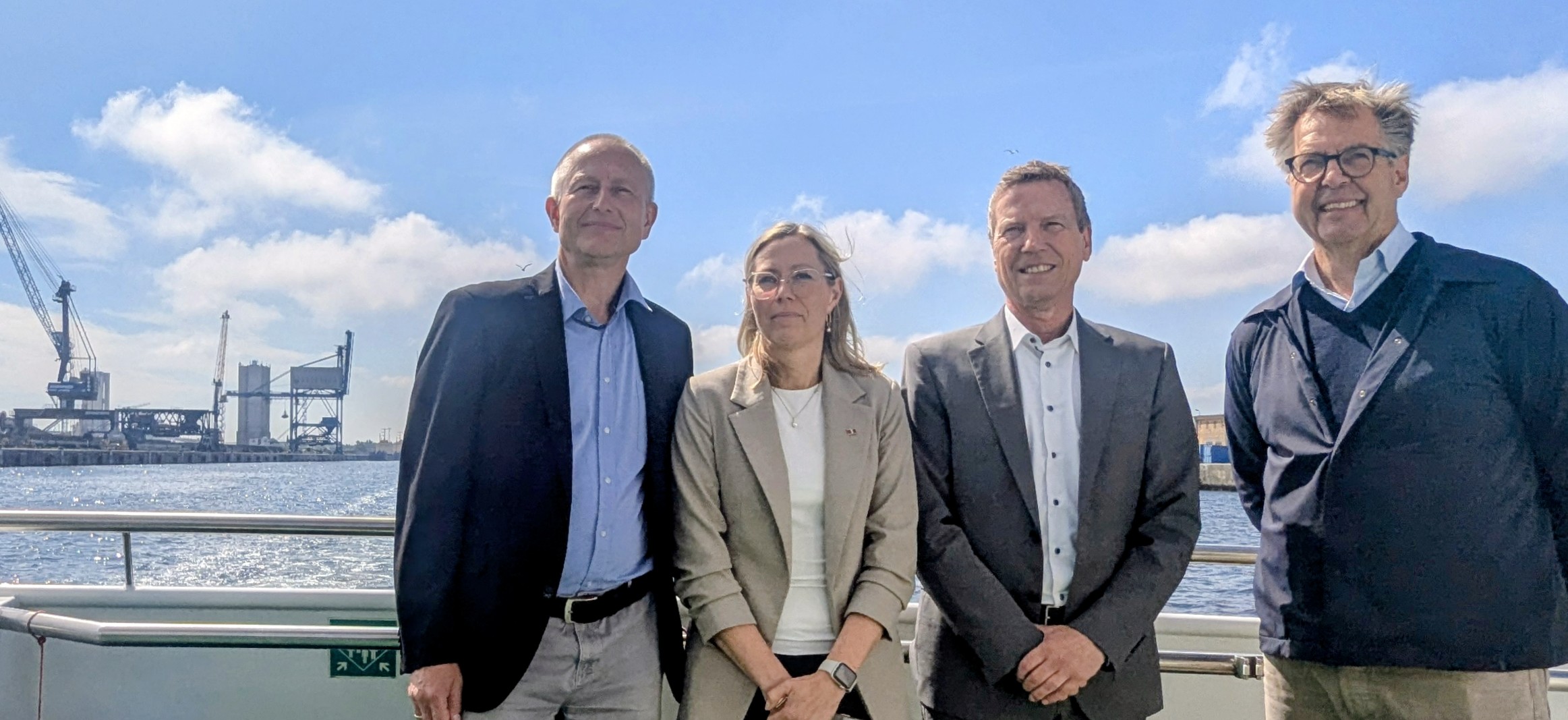
In the photo, from left to right: Dr. Gernot Tesch, Managing Director of ROSTOCK PORT GmbH; Katrin Verner, Head of the Cargo Department at Stena Line; Heiko Kähler, Managing Director of Scandlines; and Hanns Heinrich Conzen, Managing Director of TT-Line. In the photo, from left to right: Dr. Gernot Tesch, Managing Director of ROSTOCK PORT GmbH; Katrin Verner, Head of the Freight Department at Stena Line; Heiko Kähler, Managing Director of Scandlines; and Hanns Heinrich Conzen, Managing Director of TT-Line.
For further information please visit www.rostock-port.de
PM for Download: as PDF